

What happens after you sign with a literary agent?
Submitting to literary agents can be a long-winded process, and what comes after can feel a bit mysterious to authors – what exactly happens once you sign a contract and gain literary representation?
Let me walk you through the typical stages of working with a literary agent beyond the contract.
The celebration phase
It might seem like an obvious one, but the first thing you should do is celebrate! Often, the submission process is time-consuming, and authors spend months, if not years, sending out their work in the hopes of landing a literary agent. So finally receiving an offer of representation and a contract is a milestone worth celebrating.
There may be social media announcements where you share the good news. (Though it’s wise to check with the agent if this is OK first.) You may be added to the literary agency’s website too, which can make it all feel more real.
Lots of authors mark the occasion by doing something special – a glass of wine, a celebratory meal with loved ones, and so on.
If it’s a possibility, you might even go and meet your new literary agent in person. By this point, you will probably have spoken to the agent on the phone or on a video call. But if they are in the same country as you, or within travelling distance, the agent could invite you to lunch or dinner, which is always a special moment.
After I signed with my agent, she invited me to lunch in London. She showed me her office, and I got a paper copy of my contract and a lovely handwritten postcard.
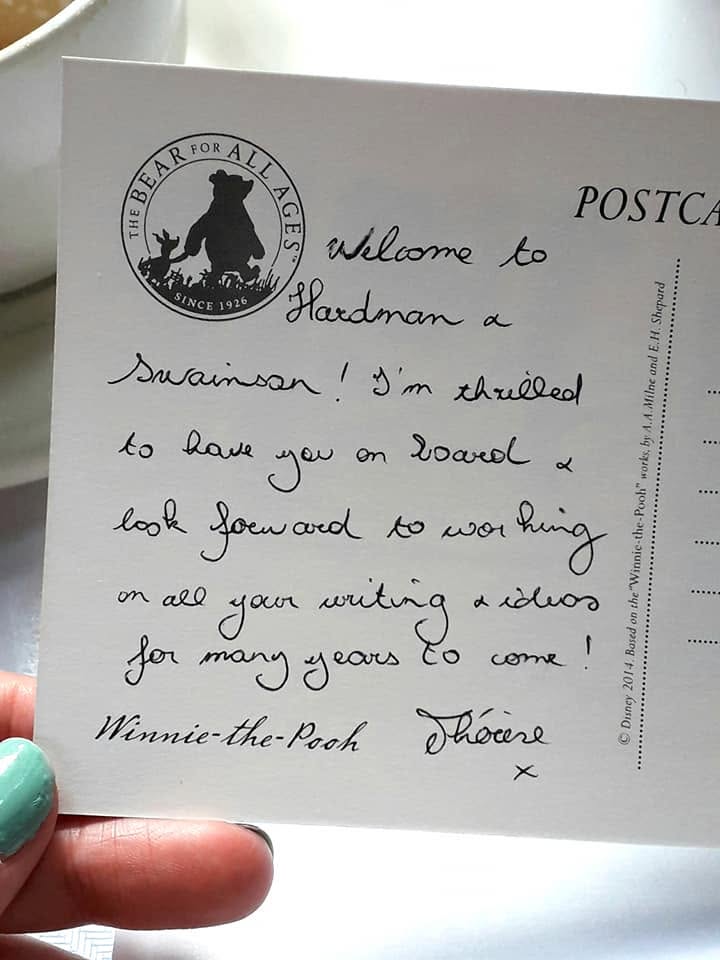
(We have indeed worked together for many years now, and have even moved to a different literary agency together.)
Now, when the celebrations are done, it’s time to get to work…
Working on revisions with your literary agent
After signing the contract, it’s typical to do a round or multiple rounds of revisions on your manuscript with your literary agent.
You may have revised before you even signed your contract, and might have even carried out a revise and resubmit (R&R) request. But it’s still common to do more edits!
Your agent will read your manuscript and write an editorial letter – a detailed letter suggesting changes you could make. These might be things like adjustments to the plot and character arcs, fixing pacing issues, enhancing the setting, or changes to give the book a better chance of being picked up by a publisher.
The agent will likely have discussed all their ideas for revisions with you before you signed your contract, so there shouldn’t be any nasty surprises here.
This stage of carrying out revisions could go on for several months until the agent feels the book is ready to submit to publishers.
Building a submission list and strategy
When your book is ready, your agent will discuss their submission strategy with you – why they have targeted certain houses, the reasoning behind the size of the list, etc. (For instance, some genres may have shorter submission lists purely because there aren’t as many publishers available for those genres.)
The agent will send you a “submission list”. This will include the names of the publishing houses/imprints and the editors they plan to send your book to.
They should send you this list before your work is even sent out, so you can check it over and approve it.
When you’re happy with everything, the agent will send your work out to everyone on the list. Cue the nail-baiting…

The waiting game and responses
This is where you as the author have to do a lot of waiting. Just like submitting to agents, submitting to publishers is a slow process.
You’ll have a choice to make here, too: Do you want to see your rejections? Do you only want good news? You can tell your agent to forward you every response that comes in (including rejections), or you can ask them to only contact you if it’s good news.
This is a very personal decision so it’s entirely up to you. When I first went on submission, I was so excited, I wanted to know about every little development. After a while, the rejections began to wear me down, so I asked my agent only to contact me if there was a positive development.
What if the book doesn’t sell to a publisher?
Unfortunately, it’s very common for a book to remain unsold – even after you’ve done the hard work of signing with a literary agent, revising, and sending your work to publishers. This can be very upsetting to writers, but it’s more common than you think.
Case in point: it took me seven years to land a book deal, and I submitted four manuscripts to publishers before one sold!
Your literary agent should have a plan for what to do if this happens – they might ask if you have ideas for other manuscripts you’d like to work on or if you’d consider a new genre or age group. You can pitch them new ideas, and try again with something fresh.

What does a literary agent do if you receive an offer?
The exciting moment might come when you receive an offer from a publisher! This is huge as it means you’re going to be published!
If it’s your first ever offer for a book deal, your agent will probably give you a call to deliver the news more directly and in a more personal way. (Be careful not to scream their ear off in your excitement.) They will let you know the publisher and the details of the offer – such as the size of the advance and whether it’s a one-book deal or if they want to sign you for two books.
After they’ve given you the good news, you’ll receive an email with all the details too.
Any other publishers who are considering the book will now have time to throw their hat into the ring and consider if they want to make an offer too. The agent usually sets a deadline for this.
If another publisher offers, the book goes to what we call “an auction”. It’s not a literal auction where everyone sits around with little number cards! It’s just a term for multiple publishers giving offers. The agent will check if anyone wants to improve their final offer before the deadline.
When all the offers are in, the author has the very exciting – though sometimes difficult! – decision of choosing which publisher they want.
Publishers may try to win over authors in lots of unique and creative ways. When my book went to auction, the publisher and editor I ultimately chose put together a lovely presentation about why they loved my book. And my editor wrote me a letter that brought me to tears.
An auction is a great situation to be in because it creates buzz around the book even before it’s released. Your agent can then use that buzz in other ways – to try to sell translation rights and film/TV rights, for example.
How the partnership with your agent evolves
Your relationship with your literary agent doesn’t end when you land your publishing deal! They will be present throughout your career.
When you are offered your book deal, they’ll negotiate the best possible terms for your contract. If there are any disagreements or disputes, they’ll be there to step in and smooth things over. They’ll be working to sell other rights for you, such as translations.
And of course, they will be there to help you land your next contract for any future books!
I hope this post gave you a glimpse behind the curtain about what happens when you sign with a literary agent!
If you are still in the submission trenches, remember that persistence is often one of the main qualities that leads writers to success. There’s a lot of rejection involved in the industry, but if you can adapt to that and keep going, you never know what might happen.
Looking for a professional edit on your manuscript or submission materials? Let’s work together.


